Dr. Charles A. Eastman, M.D. (1858-1939), also known by his
Dakota name Ohiyesa, was an extraordinary man of the Wahpeton Santee people (a
Siouan band of Dakota-speaking people). I’ve
had the inspiring pleasure of reading one of his books some years ago, The Soul of an Indian. He’s the primary reason why I’ve opted to
investigate the closely-related tribal nations of the Santee (Dakota), Teton
(Lakota), and Wiciyela (Nakota) peoples for my Reflexivity project, in fact.
Having long been interested in learning more about his life,
I was pleased to find Paula Giese’s
biography on Dr. Eastman through the Native
American Authors web page. Giese
provides well cited information about him, with a bibliography that includes Eastman’s
own books. Her account of the life and
times of this eloquent American Indian advocate, while on the brief side and suffering
from a few grammatical errors and broken links, nonetheless portrays an
accurate account of the good doctor’s life.
When he graduated from Boston University Medical School in
1890, Dr. Eastman was one of the first American Indians to earn a medical
degree. Unlike many other American
Indian advocates of his generation, Eastman was traditionally raised by his
grandmother, Uncheeda, in the Santee tradition.
He did not enter the white American world until age fifteen. It was at this time that his father, Many
Lightnings, who had participated in a Santee reservation uprising fueled by very
inadequate food and horrendous treatment by the U.S., returned from prison. Taken aback by the overwhelming power of the
United States he’d experienced firsthand, Many Lightnings had Ohiyesa baptized
into Christianity as Charles A. Eastman, and sent him to the Flandreau Santee
Normal Indian School. Eastman tells us,
in Soul of an Indian (page xi) that his
father advised him, “it is the same as if I sent you on your first warpath. I
expect you to conquer.”
Dr. Eastman wanted to use his medical education to serve his people.
He found an opportunity to do so at the
Pine Ridge Indian agency in South Dakota, where he was hired as a physician. He met his wife-to-be here as well, the newly
appointed agency’s white supervisor Elaine Goodale. Goodale was sympathetic to American Indians,
and advocated for their welfare and education.
At the Wounded Knee Massacre, Eastman witnessed
firsthand the sheer cruelty the United States was capable of. Many unarmed Lakota men, women, and children
were slaughtered by the U.S. 7th Cavalry in this massacre. Their bodies were left to freeze in the
blizzard that came soon after that night. Both Eastman and Goodale spent the night and the
following day rescuing and medically treating the survivors. Dr. Eastman would soon after find himself fired
by his supervisors for favoring American Indian needs over conflicting Bureau
of Indian Affairs policies his position required him to follow.
The married couple moved to St. Paul Minnesota, where Dr.
Eastman practiced medicine again for a short time. But he was affronted by racists who could not
believe an American Indian man could legitimately obtain a medical license or
possess the wherewithal to practice medicine.
Now with two children, Eastman decided to drop the fight and found work
as a program organizer for the YMCA on reservations. He also worked for a time at the Carlisle
Indian Industrial School. At Carlisle, he
met Lakota activist and writer Zitkala-Sa
who encouraged Eastman to begin his writing career.
Dr. Eastman went on to become a courageous orator and writer,
advocating on behalf of American Indians more broadly. His writings leave us with a heartfelt portrayal
of his native people’s profound spiritual and social values, which he sought to
educate white audiences about. They also
reflect his own perpetual conflict, the struggle to live in a hostile world,
ever treading the line between native and white ways, or as he described them the
ways of life based on spirit and life based on commerce, respectively. He found the teachings of Jesus to be in
essence identical with his native religion, despite the hypocrisy of Christians
who sought after material wealth at all costs. His background in both worlds made Dr. Eastman
uniquely qualified among the prominent American Indian advocates of his era to directly
educate white audiences about native social and spiritual values.
His life’s work also revolved around combatting the
injustices suffered by American Indians more broadly, including treaty
violations and the concerted efforts of whites to annihilate native culture
such as through boarding schools. Dr.
Eastman also sought to keep the old stories of his people alive for children in
particular. Indeed, his concerns for both
native values and children led him to help pioneer the Boy Scouts program in
America. He believed it was a great way
to teach non-white children the sense of wonder and values he’d experienced
growing up in the wild, helping to bridge the divide between two worlds.
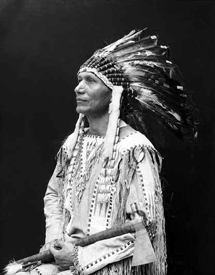
Image courtesy of LegendsOfAmerica.com
Works Referenced
Eastman, Charles Alexander. The Soul of an Indian: And Other Writings from Ohiyesa (Charles
Alexander Eastman). Ed. Kent Nerburn. Novato: New World Library, 2001.
Print.
Eastman, Charles Alexander. The Essential Charles Eastman
(Ohiyesa): Light On the Indian World. Ed. Michael Oren Fitzgerald. Kindle
ed. World Wisdom, 2007. eBook.
Giese, Paula. “Dr. Charles A. Eastman.” Native American Indian Resources. 13
July 1996. Web. 5 Aug. 2016. <http://www.kstrom.net/isk/stories/authors/eastman.html>.

No comments:
Post a Comment